Why Wayfinding Design Services Will Change the Way You Think About Brand Trust
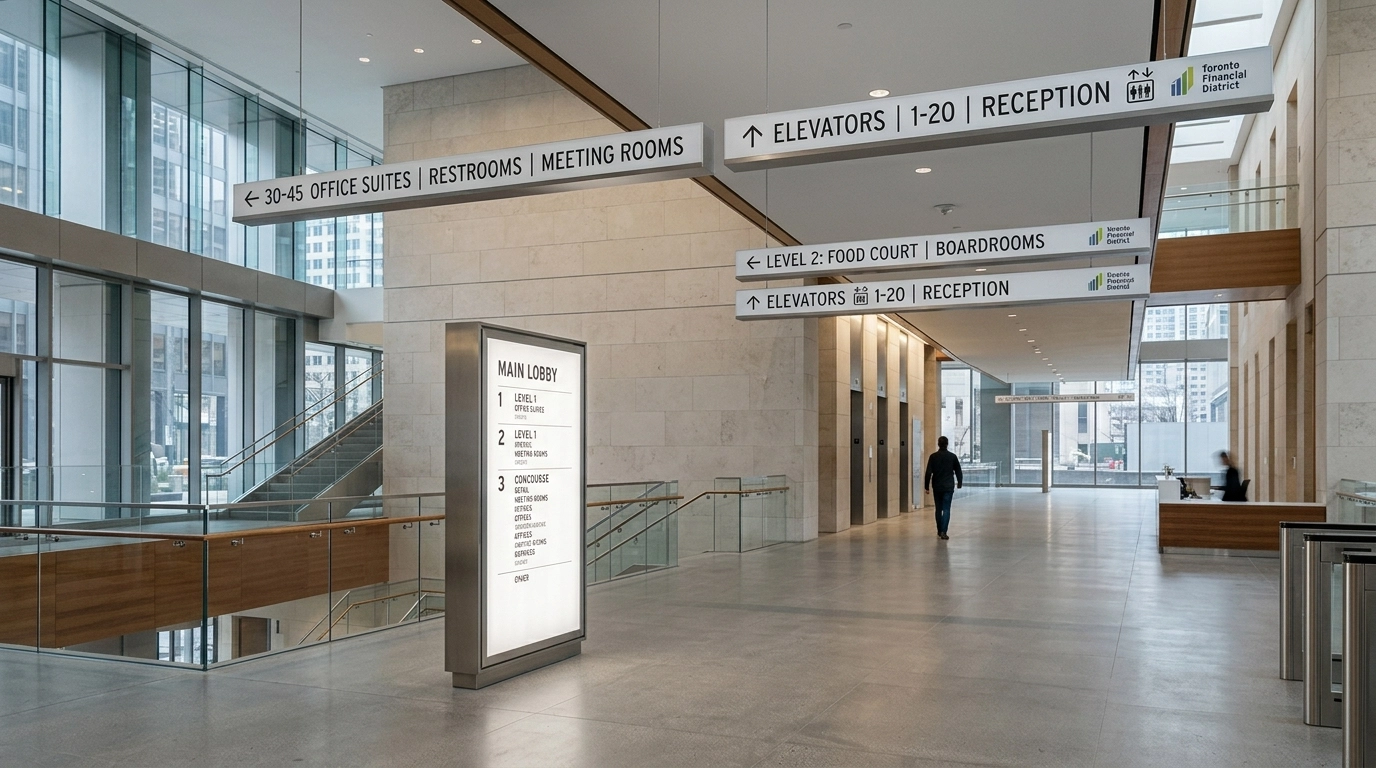

Imagine walking into a large medical office in Markham for an important appointment. You’re already a few minutes late. You scan the lobby, but there is no clear direction on where to find Suite 402. The elevator buttons are unlabeled, and the hallway looks like a labyrinth of identical white doors. Within sixty seconds, your heart rate is up, your frustration is peaking, and you’ve already formed a subconscious opinion about the quality of care you’re about to receive. This is the "confusion tax" in action. Professional wayfinding design services are not just about pretty signs; they are the frontline of your brand’s credibility. If a visitor cannot navigate your physical space, they will struggle to trust your professional expertise.
The Invisible Link Between Navigation and Credibility
Trust is a fragile thing, especially in a business environment. We often think of brand trust in terms of five-star reviews or a glossy website, but in the physical world, trust is built through a series of small, successful interactions. When a customer enters your building in Toronto or any of the surrounding GTA hubs, they are looking for cues that you are in control of your environment.
If your space is cluttered, confusing, or lacks clear signage, you are inadvertently telling your visitors that you are disorganized. It suggests that if you can't manage your own hallways, you might not be able to manage their project, their health, or their retail experience effectively. Wayfinding design services bridge this gap by translating your brand’s promise of reliability into a physical reality that people can see and follow.
The Psychology of Being Lost
There is a primitive part of the human brain that reacts poorly to being lost. It triggers a mild stress response. When a visitor feels "trapped" or unsure of their next move, their focus shifts from your products or services to their own discomfort. This is the opposite of a positive customer experience.
A clear environment, on the other hand, provides a sense of security. When a person knows exactly where they are and where they need to go, they relax. They become more open to your messaging and more likely to engage with your brand. By investing in wayfinding design services, you are essentially investing in your customer’s peace of mind. You are proving that you value their time and their comfort.
Visibility as a Competitive Advantage
In the crowded markets of the Greater Toronto Area, standing out is often a matter of being the most helpful option. Visibility goes beyond a logo on the front door. It’s about the visibility of the path forward.
We often see business owners who suffer from "the curse of knowledge." You know your office or store like the back of your hand, so the layout seems obvious to you. But to a first-time visitor, it’s a blank slate. Practical wayfinding takes that insider knowledge and externalizes it. It makes the "obvious" actually obvious to the person who has never been there before.
Creating a Powerful First Impression
You only get one chance to make a first impression, and in a physical location, that impression begins at the curb or the parking garage. If a client has to wander around a parking lot looking for the right entrance, you’ve already lost points before they’ve even walked through the door.

A cohesive navigation strategy ensures that the transition from the outside world to your branded environment is seamless. It uses consistent colors, fonts, and materials to tell a story of professionalism. This consistency is a hallmark of brand trust. It shows that every detail of the customer experience has been considered and refined.
The Problem with DIY Signage
We’ve all seen it: the printed-out A4 paper taped to a glass door with "Entrance Around the Corner" written in marker. While well-intentioned, these temporary fixes are trust-killers. They look cheap, they look temporary, and they scream "unprepared."
Professional wayfinding design services replace these stop-gaps with permanent, high-quality touchpoints. At Visual99, we focus on environmental branding that integrates your visual identity directly into the architecture of your space. This isn't just about placing an "Exit" sign; it's about using materials that reflect your brand's quality: whether that’s brushed metal for a high-end law firm in downtown Toronto or warm wood tones for a community center in Richmond Hill.
Practical Steps to Improve Spatial Clarity
If you’re wondering where to start with your own space, look at it through the eyes of a stranger. Here is a practical checklist to evaluate your current navigation:
- The Threshold Test: Stand at your main entrance. Can you see exactly where to go next without asking for help?
- The Language of Signs: Are your signs using jargon, or are they clear? Instead of "Administrative Solutions Hub," maybe just use "Reception."
- Consistency Check: Do your directional signs look like they belong to the same family as your logo and website?
- Accessibility: Can someone with a visual impairment or a stroller navigate your space as easily as anyone else?
Improving these elements doesn't have to happen all at once, but it does require a strategic approach. Wayfinding design services look at the flow of people: the "traffic patterns": to determine where confusion is most likely to occur. By placing signs at these "decision points," you eliminate the hesitation that leads to a negative experience.
Solving the Client Confusion Gap
Our main USP at Visual99 is our obsession with clarity. We specialize in identifying the gap between what a business owner thinks is clear and what a customer actually experiences. This is particularly important for organizations with complex layouts like hospitals, large retail chains, or multi-tenant office buildings.
We use environmental branding to bridge the gap between your digital presence and your physical reality. If your website is sleek and modern, but your office navigation is a mess of old plastic signs, your brand trust will take a hit. We make sure the two worlds speak the same language.
Wayfinding as a Long-Term Investment
Many business owners view signage as a late-stage expense in a renovation. In reality, it should be part of the initial brand experience strategy. When wayfinding is baked into the design of a space, it feels natural. It doesn't look like an afterthought; it looks like an essential part of the environment.
In the GTA, where real estate costs are high and competition is fierce, making the most of your physical square footage is vital. Every square foot that a customer spends feeling lost is a wasted square foot. Every minute a staff member spends giving directions to a lost visitor is a wasted minute. Effective wayfinding pays for itself by increasing operational efficiency and boosting customer satisfaction.
Conclusion: Trust is Built Through Clarity
The relationship between wayfinding design services and brand trust is direct and measurable. When you remove the barriers to navigation, you remove the barriers to a successful business relationship. You move from being "the place that’s hard to find" to being "the place that’s easy to work with."
A clear space is a professional space. It tells your clients that you have a plan, you are organized, and you care about their experience. In an era where digital interactions are often fleeting, your physical space is one of the few places where you can truly ground your brand in reality.
If you are looking to audit your current space or are planning a new location in Toronto, Markham, or across the GTA, we are here to help you solve the problem of spatial confusion.
If you're working on a similar project and want to ensure your physical environment is working for your brand rather than against it, we're happy to help. Let's make your space clear, practical, and worthy of your customers' trust. Contact us to start the conversation.
Have A Project In Mind?
Tell us the scope, approximate dimensions, and your timeline. We typically respond within two business days.
Discuss Your Project